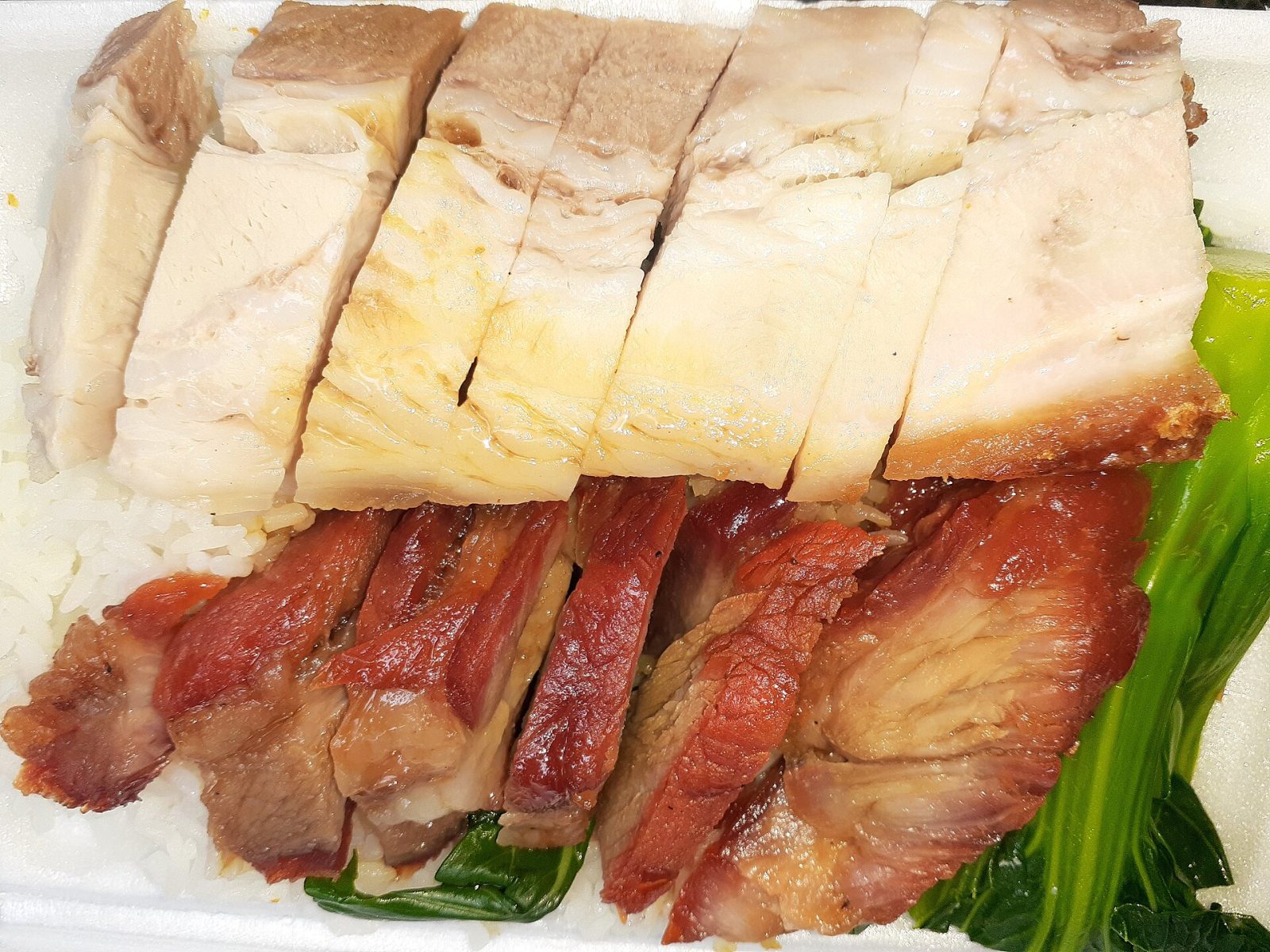
Char Siu (叉燒) — Cantonese Barbecued Pork
Declassified 22 August 2026
Threat assessment
- 1 No contact Nobody is in danger. Least of all the locals.
- 2 Light resistance A warmth. You mention it. Nobody responds.
- 3 Engaged You are sweating. No one else at the table is sweating.
- 4 Taking fire You have stopped talking. A child has taken your portion.
- 5 Operative down Extraction required. Locals describe this one as "not spicy".
Char siu is the lacquered, sweet-savoury barbecued pork that hangs in every siu mei window in Hong Kong, sliced to order over rice with a ladle of its own syrup. The flavour comes from an overnight marinade of red fermented bean curd, ground bean sauce, rose wine and five spice; the finish comes from hard dry heat and repeated thin coats of maltose glaze. A good one is cut from a well-marbled collar or shoulder butt — 半肥瘦, half fat half lean — so the fat seams melt into the meat instead of drying out, and it always carries blackened, slightly bitter edges against the sweet lacquer. Unlike roast goose, it needs nothing more exotic than a domestic oven and a wire rack. Photo: HAO ACKuSANE Husxima (CC BY-SA 4.0), via Wikimedia Commons.
// SUPPLY LIST
SCALE:
| AMT | UNIT | ITEM |
|---|---|---|
| 1.2 | kg | Pork collar or shoulder butt (梅頭), boneless and skinless, visibly marbled, cut with the grain into strips 20-25 cm long, 5 cm wide and 3 cm thick |
| 80 | g | Caster sugar |
| 45 | ml | Light soy sauce |
| 30 | ml | Oyster sauce |
| 30 | g | Ground bean sauce (磨豉醬), mashed smooth against the side of the bowl |
| 2 | piece | Red fermented bean curd (南乳), cubes mashed to a paste, plus 1 tbsp of the brine from the jar |
| 30 | ml | Rose wine (玫瑰露酒, about 54% ABV); or 30 ml Shaoxing wine plus 2 drops of food-grade rose water |
| 1.5 | tsp | Chinese five spice powder |
| 4 | clove | Garlic, finely grated to a paste |
| 1 | piece | Asian shallot, finely grated |
| 1 | tbsp | Toasted sesame paste (芝麻醬), stirred smooth |
| 0.5 | tsp | Ground white pepper |
| 1 | tsp | Dark soy sauce |
| 1 | tsp | Red yeast rice powder (紅麴粉), for the traditional brick-red edge — optional |
| 2 | tbsp | Neutral oil, for oiling the wire rack and for the blanching water |
| 120 | g | Maltose (麥芽糖), spooned out with a spoon dipped in boiling water |
| 60 | ml | Just-boiled water, for loosening the glaze |
| Fine salt, for the blanching water | ||
| 600 | g | Choy sum, trimmed and washed, to serve |
| 480 | g | Jasmine rice, rinsed and steamed, to serve |
| English or Chinese hot mustard, to serve |
// OPERATIONS
- 1 Cut the pork with the grain into strips 20-25 cm long, 5 cm wide and no thicker than 3 cm, leaving every seam of fat in place — the fat is the dish, not a defect, and trimming it out gives you dry, stringy meat. Do not substitute loin or tenderloin however lean you want it: they carry no intramuscular fat, they seize at the temperature char siu needs, and no glaze will rescue them. Prick each strip 15-20 times all over with a fork or metal skewer so the marinade travels past the surface instead of sitting on it.
- 2 In a large non-reactive bowl, whisk the caster sugar, light soy sauce, oyster sauce, ground bean sauce, mashed red fermented bean curd with its 1 tbsp brine, rose wine, five spice, grated garlic and shallot, sesame paste, white pepper, dark soy and the red yeast rice powder if using, for a full 2 minutes until the sugar has completely dissolved and no lumps of bean curd remain — grit under the whisk means it is not ready, and undissolved sugar scorches into black specks in the oven. It should taste startlingly sweet and salty on a clean spoon; it is seasoning 1.2 kg of meat, not dressing a plate. The siu mei shops get their scarlet edge from food colouring, while red yeast rice is the older, natural route and gives a duller brick red, which is what you want at home.
- 3 Measure 75 ml of the marinade into a small covered container and refrigerate it separately — this is your glaze base and the only marinade that will stay clean. Turn the pork through the rest, in the bowl or a zip bag, massaging for 1-2 minutes until every surface is coated and the liquid feels tacky rather than runny, then cover and refrigerate for 24 hours, turning the strips twice. Twelve hours is the absolute floor: the fermented bean curd and ground bean sauce need overnight to travel through 3 cm of muscle, and a two-hour marinade gives you a seasoned crust wrapped around bland grey pork.
- 4 Take the pork out of the fridge 45 minutes before roasting and let it come to room temperature on a plate, still coated, until the strips no longer feel cold on the underside. Meat going in fridge-cold needs so much extra oven time that the surface sugars blacken long before the centre is anywhere near safe.
- 5 Heat the oven to 230°C / 450°F conventional (210°C / 410°F fan), with a shelf in the upper third. Line a deep roasting tray with foil, pour in 500 ml water, and set a wire rack rubbed with about 1 tbsp of the neutral oil over it so the pork will sit at least 3 cm clear of the water. The water tray is not optional: sugary drippings landing on dry hot metal smoke hard, turn acrid, and that bitterness settles straight back onto the meat — glance at it halfway through and top it up with a splash of hot water if it is close to dry.
- 6 Make the glaze in a small saucepan: the reserved 75 ml clean marinade, the 120 g maltose and the 60 ml just-boiled water. Warm over a low heat, stirring, for 3-4 minutes to a bare simmer, until the maltose has fully dissolved and the syrup runs off the back of a spoon in a thin unbroken ribbon. Do not let it boil hard — reduced too far it sets to toffee as it cools and cannot be brushed. If you also want the marinade left clinging to the bowl, tip that into a separate pan and hold it at a full rolling boil for 2 full minutes before combining, because it has been sitting on raw pork for a day.
- 7 Lay the strips on the rack fat-side up with 3 cm of clear air between them — crowded strips steam each other and stay pale and slack — and roast for 15 minutes. Leave the glaze alone at this stage: sugar brushed on now will be carbon long before the pork is cooked. You are looking for the surface to dry, dull and tighten, with the thin edges just starting to take colour.
- 8 Turn each strip with tongs and roast a further 12 minutes, then push an instant-read thermometer into the thickest part of the thickest strip — it should read 55-58°C / 131-136°F. If it is lower, keep roasting in 4-minute increments until it gets there, because every timing from here is measured off this point and a cold centre will still be raw when the outside is finished.
- 9 Drop the oven to 200°C / 390°F conventional (180°C / 355°F fan) — holding 230°C once sugar is on the meat carbonises the glaze and drives the centre straight past its target — then brush the strips with a thin, even coat of warm glaze and return them for 6 minutes. Flip, glaze the second face, and give them another 6 minutes, by which point each coat should look glossy and set rather than wet. Build the lacquer in thin layers rather than one heavy coat: a thick coat slides off, pools in the tray and burns there, and it never sets glossy on the meat.
- 10 Switch the oven to the grill/broiler on high, move the whole tray and its rack up so the pork sits 8-10 cm below the element with the water still underneath, and stand at the door for the entire 2-3 minutes. You want the ridges of fat and the thin edges to blister and blacken in patches — char siu is meant to have burnt edges (焦邊), and the gap between charred and ruined is about 45 seconds. Pull it out when the thermometer reads 68-72°C / 154-162°F in the thickest strip; if it reaches that before the edges have caught, take it out anyway rather than chasing colour into dry meat.
- 11 Rest the strips on the rack, uncovered, for 10 minutes — carryover will carry them to around 74°C / 165°F — then brush a final coat of warm glaze over both sides so the residual heat sets it to a sticky, mirror-like lacquer. Do not tent with foil: the trapped steam softens the glaze you have spent the last quarter of an hour building and the crust goes slack. Slicing before the rest is over will empty the juices onto the board.
- 12 While it rests, bring a large pan of well-salted water to a rolling boil, add 1 tsp of the remaining neutral oil, and blanch the choy sum in two batches for 90 seconds each — crowding drops the water off the boil and turns the stems khaki — until they are bright green and the stems bend under their own weight. Slice the pork across the grain 5-8 mm thick with a sharp knife and serve over the steamed jasmine rice with the choy sum, the remaining warm glaze spooned over the rice, and hot mustard on the side. Leftovers keep 4 days in the fridge and are the correct filling for char siu bao and fried rice; reheat slices in a dry pan over a medium heat, not a microwave, which turns the lacquer to rubber.