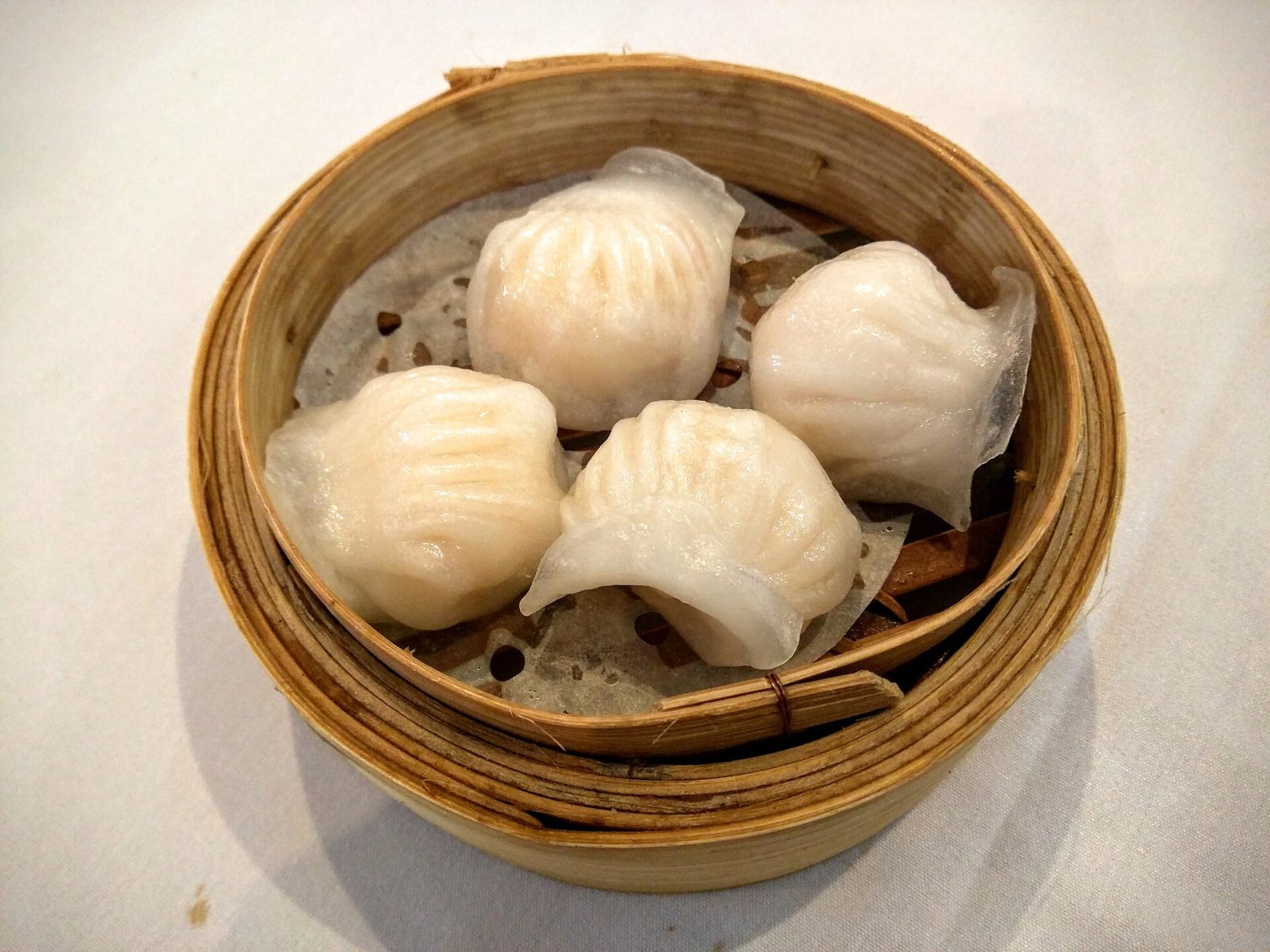
Har Gow (蝦餃) — Crystal Prawn Dumplings
Declassified 22 August 2026
Threat assessment
- 1 No contact Nobody is in danger. Least of all the locals.
- 2 Light resistance A warmth. You mention it. Nobody responds.
- 3 Engaged You are sweating. No one else at the table is sweating.
- 4 Taking fire You have stopped talking. A child has taken your portion.
- 5 Operative down Extraction required. Locals describe this one as "not spicy".
Har gow are the crystal prawn dumplings a Hong Kong dim sum kitchen is judged on: a boiling-water wheat starch wrapper pressed paper-thin with an oiled cleaver blade, pleated along its spine, and steamed hard until it turns glassy over a pink filling of prawn, pork back fat and bamboo shoot. A good one is translucent without being torn, holds its crescent when you lift it with chopsticks, carries at least seven pleats and ideally ten or more, and the prawn inside snaps rather than crumbles. The wrapper dough is the technical part and it is entirely manageable at home, provided the water is genuinely at a rolling boil and you work fast while the dough is hot. This makes about 30 dumplings, enough for six people as part of a wider yum cha spread. Photo: Maksym Kozlenko (CC BY-SA 4.0), via Wikimedia Commons.
// SUPPLY LIST
SCALE:
| AMT | UNIT | ITEM |
|---|---|---|
| 400 | g | Raw prawns, shelled and deveined (from about 550 g headless shell-on, 21/25 count) |
| 2 | tbsp | Fine salt, for scrubbing the prawns (rinsed away, does not season the filling) |
| 60 | g | Pork back fat, skin removed, in one piece |
| 70 | g | Winter bamboo shoot, vacuum-packed or tinned (already cooked), drained and rinsed |
| 2 | tsp | Caster sugar |
| 0.75 | tsp | Fine sea salt, for the filling |
| 0.5 | tsp | Ground white pepper |
| 2 | tsp | Toasted sesame oil |
| 2 | tsp | Tapioca starch, for binding the filling |
| 130 | g | Wheat starch (澄麵, non-glutinous wheat starch — not plain flour) |
| 35 | g | Tapioca starch, for the dough |
| 0.25 | tsp | Fine sea salt, for the dough |
| 210 | ml | Water, brought to a full rolling boil in a small pan |
| 25 | g | Lard, soft, for the dough and for oiling the blade, steamer and dumpling bases |
| Chilli oil, to serve |
// OPERATIONS
- 1 Scrub the prawns for snap: put the 400 g of shelled prawns in a bowl, add 1 tbsp of the fine salt and rub them firmly between your palms for 30 seconds, until they feel tacky and the surface slime goes cloudy, then rinse under cold running water for a full minute. Repeat with the second tablespoon and rinse until the water runs clear and the prawns squeak against your fingers — all of this salt goes down the drain, so it does not season anything; it is there to strip slime and firm the flesh. Sit them in a bowl of cold water for 10 minutes, drain, blot hard between tea towels, then spread them in a single layer on a plate and leave uncovered in the fridge at 4°C/39°F for 1 hour to dry. Hong Kong restaurant kitchens often add a pinch of bicarbonate of soda at this stage; at home the salt scrub plus a cold dry firms the prawn just as well without the faintly soapy, metallic edge bicarb leaves, but you cannot skip the drying, because surface water steams the prawn soft and mealy instead of snapping.
- 2 Bring a small saucepan of water to the boil and simmer the 60 g piece of pork back fat for 8 minutes, until it is firm all the way through and the edges have turned translucent, then lift it into cold water to cool — raw fat smears under the knife rather than dicing. Blanch the 70 g of drained bamboo shoot in the same water for 3 minutes to drive off its tinny brine smell; this assumes the vacuum-packed or tinned shoot called for, which is already cooked, and if you are instead working from a genuinely raw fresh winter shoot you must peel it and boil it in fresh water for 25 to 30 minutes first, until a skewer slides in and a raw sliver tastes sweet rather than bitter, because raw bamboo is harshly bitter and its cyanogenic compounds only break down with long boiling. Drain both, cut the fat and the bamboo into neat 3 mm dice, then squeeze the diced bamboo hard in the corner of a tea towel: wet bamboo weeps inside the steamer and splits the wrapper from within.
- 3 Cut about two-thirds of the dried prawns (roughly 270 g) into 1 cm chunks, and mash the remaining third to a coarse, sticky paste with the flat of a cleaver, around 20 strokes, or 8 short pulses in a processor — stop while it still shows torn fibres rather than going smooth. This two-texture split is the whole point of har gow: all chunks and the filling falls out of the wrapper in pieces, all paste and you get a bouncy pink sausage instead of prawn that snaps.
- 4 Combine the prawn chunks and paste with the diced fat and bamboo, 2 tsp caster sugar, 3/4 tsp fine salt, 1/2 tsp white pepper, 2 tsp sesame oil and 2 tsp tapioca starch, and stir hard in one direction only with chopsticks for 60 to 90 seconds, until the mixture stiffens, clings to the chopsticks and pulls away from the side of the bowl as a single mass. Press cling film onto the surface and chill at 4°C/39°F for at least 2 hours, or overnight, until a scooped ball holds its shape without sagging — warm, loose filling is unwrappable and will bleed liquid into the wrapper. Keep the seasoning this plain: home versions often add a little ginger or chive, but the teahouse standard is prawn, fat, bamboo and seasoning, and garlic or a heavy hand with Shaoxing wine muddies the clean sweetness the dish is judged on.
- 5 For the wrapper, whisk the 130 g wheat starch, 35 g tapioca starch and 1/4 tsp salt together in a heatproof bowl, bring the 210 ml water to a full rolling boil (100°C/212°F) in a small pan, and pour it in all at once in one steady stream while stirring hard with a wooden spoon for 20 seconds, until no dry pockets remain and the mass looks like translucent porridge. Cover the bowl and leave it 2 minutes so the residual heat finishes gelatinising the starch. Pour straight from the pan rather than from a kettle carried across the kitchen: the cold starch swallows a lot of heat the instant it is wetted, and only water coming off the boil leaves the mixture above about 85°C/185°F, which is what wheat starch needs to gel properly — under-gelatinised dough cracks as you press it and steams up chalky and gluey instead of glassy.
- 6 Scrape the hot dough onto a clean unfloured worktop, work in 12 g of the lard with a dough scraper until it is cool enough to handle, then knead for 3 to 4 minutes until it is satin-smooth, faintly translucent, and feels like warm plasticine that no longer sticks to your palm. If it cracks at the edges, wet your hands and knead in 5 ml of water at a time; if it smears, dust nothing onto it, just keep kneading until it firms. Return it to the bowl under a damp cloth and keep it at room temperature on the worktop — never refrigerate this dough, because chilled wheat starch sets hard and tears rather than stretching.
- 7 Roll the dough into a 3 cm log, cut it into 12 g pieces (about 30) and keep every piece but the one in your hand under the cloth, since a cut piece skins over in around 2 minutes. Smear a film of lard on a small patch of worktop and on the flat of a cleaver blade (an oiled metal spoon or the base of a small pan does the same job), set a piece down, press it flat with the blade, then push and rotate the blade to spread it to a round 8 to 8.5 cm across and about 1 mm thick, very slightly thicker at the centre than at the rim so the base carries the filling while the edge stays thin enough to pleat. Do not press these out in flour like a jiaozi wrapper: flour will not absorb into wheat starch, it bakes to grey specks in the steamer and it stops the pleats sealing.
- 8 Lay a wrapper across a slightly cupped palm, place about 17 g of the cold filling just off-centre and press it into a flat pad, then fold to a half-moon and pinch the far corner closed. Working left to right, pleat the near edge only, taking a 4 to 5 mm tuck and pressing each pleat flat against the plain back edge so it seals as you go — seven pleats is the traditional minimum, ten or more marks a good one and thirteen is the master's count — then curve the dumpling into a crescent with the pleats running along its spine and stand it on its flat bottom. Push any trapped air out towards the open corner as you seal, because it expands in the steamer and blows the seam open.
- 9 Line a 25 cm bamboo steamer basket with perforated parchment, or with a single layer of blanched cabbage leaf, brush the base of each dumpling with a little lard and set them 2 cm apart — they puff slightly as they steam and weld to each other permanently if they touch. A 25 cm basket takes eight to ten, so expect three or four batches; keep the waiting dumplings on an oiled tray under a dry cloth rather than in the fridge. If you only have a metal steamer, tie a tea towel around the lid: bamboo drinks its own condensation, but metal drips it back onto the wrappers and a single drip dissolves a pit straight through.
- 10 Bring at least 5 cm of water in a wok or wide pan to a hard rolling boil (100°C/212°F), so steam is visibly pouring out, set the basket in, cover, and steam over the highest heat for 6 minutes, or 7 if the shaped dumplings have been sitting somewhere cold. They are ready when the wrapper has gone from chalk white to glassy grey, you can see the pink of the prawn through it, and each dumpling looks taut and slightly inflated. Do not push past 8 minutes and do not turn the heat down for a gentler steam: a slack steamer gives a cloudy, slumping wrapper, and over-steaming over-gelatinises the starch so it tears as you lift it while the prawn goes from snapping to cottony.
- 11 Lift the whole basket clear of the heat, take the lid off and let the har gow stand for 60 to 90 seconds before touching them, because the wrapper is effectively molten as it comes out and only firms as it cools — grabbing one straight away with tongs tears a hole every time. Move them with a small oiled spatula or oiled chopsticks, never by pinching the pleats.
- 12 Serve them in the basket the moment they have set, four or five to a portion so this batch fills six or seven baskets, either plain or with a small saucer of chilli oil, alongside other dim sum and a pot of hot jasmine or pu-erh tea, which cuts the pork fat. Har gow do not reheat — the wrapper turns to glue — so freeze any you are not steaming: set them raw and uncovered on an oiled tray until solid, bag them, and steam from frozen, without thawing, for 9 minutes.